Your citation record, written up the way a committee reads it
A 13-section report built from your public Google Scholar profile: where your h-index stands among peers, who cites you and from where, the themes that run through your work, five-year projections, and the collaborators, grants and positions that fit. Delivered as a PDF, dated, with a methods appendix. One payment, no subscription.
What's inside
Thirteen numbered sections plus a methods appendix, written for a tenure, promotion or grant file. Every number is reproduced from a named public source and dated.
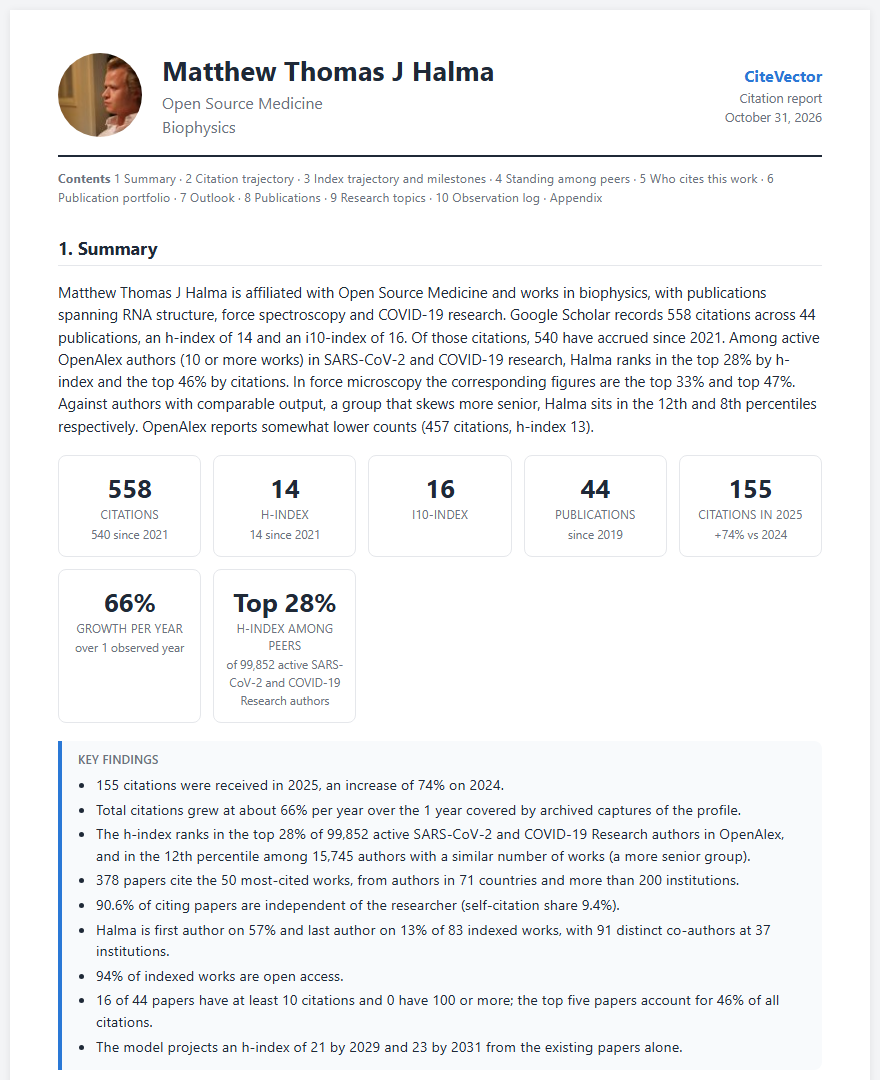
1. Summary and key findings
Headline metrics, growth, and eight to ten plain sentences you can lift straight into a dossier, with model-written commentary.
2–3. Citation and index trajectory
Your total citations, h-index and i10-index on every date the Wayback Machine captured your profile, plus dated milestones (when you passed h-index 10, 500 citations…) and the projected next ones.
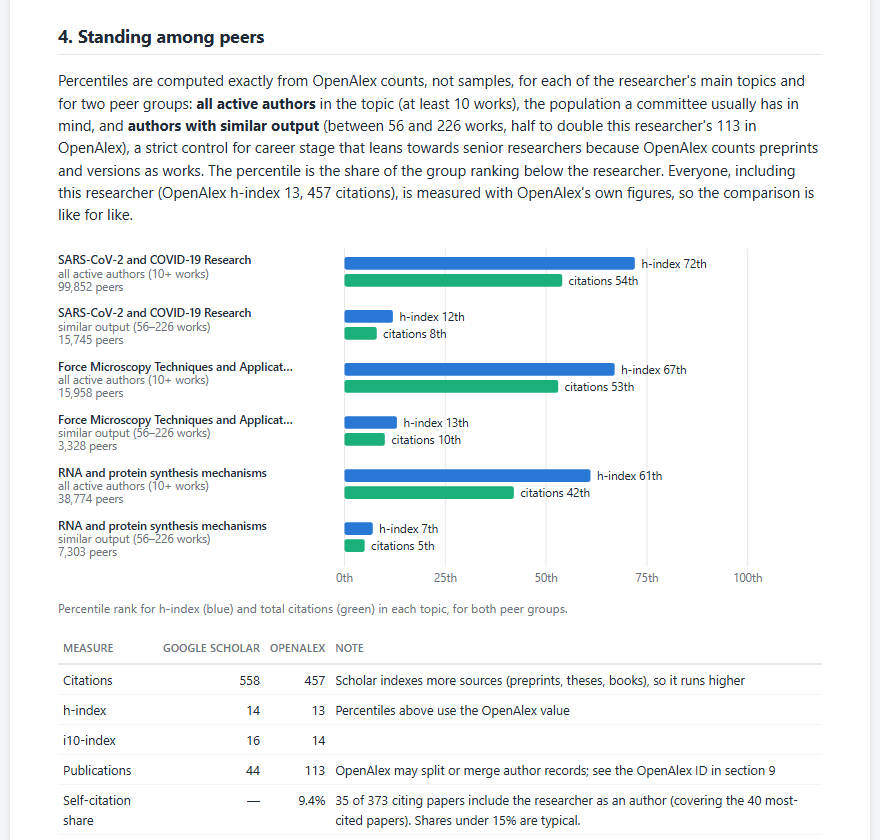
4. Standing among peers
Exact percentile ranks for h-index and citations in each of your top three topics, against all active authors and against authors with similar output. Counted from OpenAlex, not sampled.
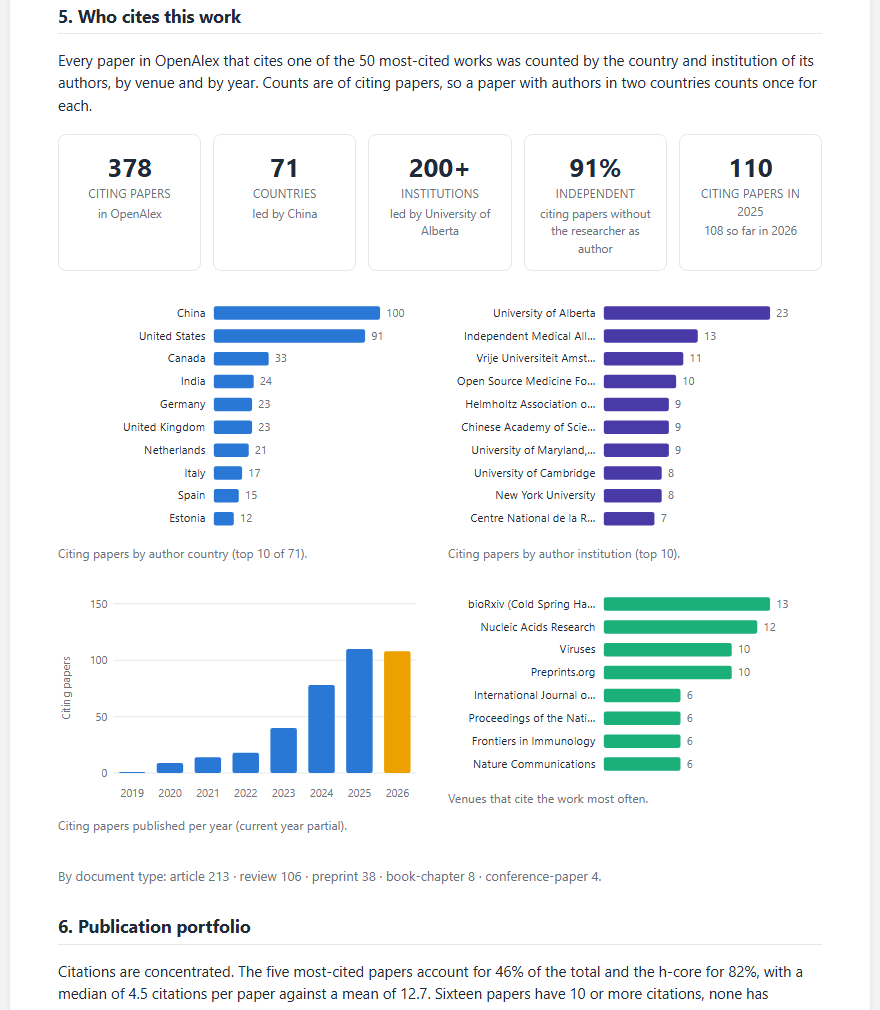
5. Who cites this work
Citing papers by country, institution, journal and year, and the share that is independent of you (self-citation share, with the typical range).
6. Publication portfolio
First- and last-author shares, co-author and institution counts, open-access share, citations by publication year, concentration (Gini, h-core share), frequent co-authors and venues.
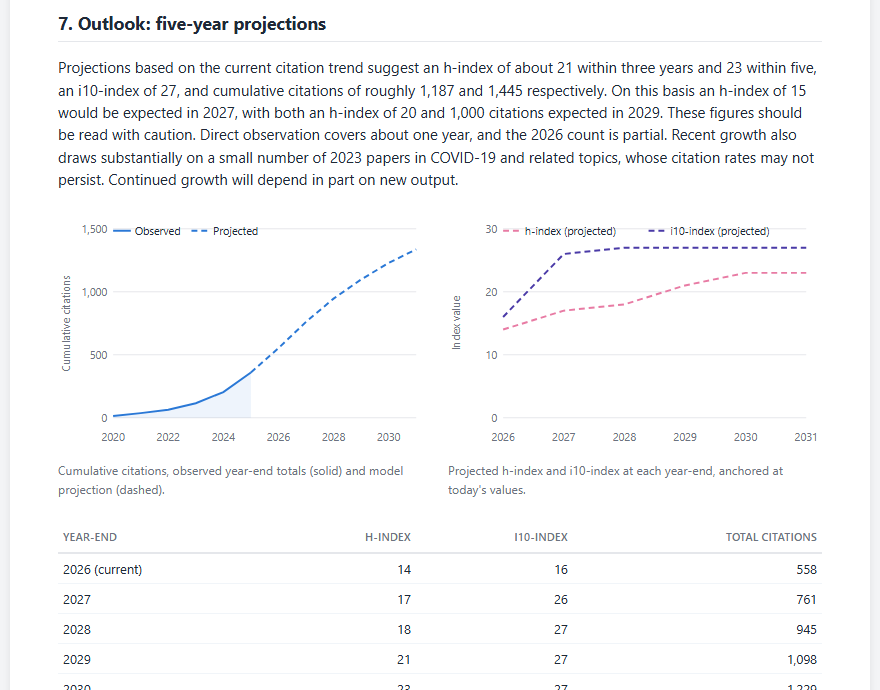
7–8. Projections and per-paper forecasts
Five-year h-index, i10-index and citation projections from the Wang–Song–Barabási model, and one-, three- and five-year forecasts for your 25 most-cited papers with DOI links.
9. Research themes
Your papers clustered into three to six themes from their abstracts, each named and described, with the throughline that connects them and how the work developed over time.
11–13. Collaborators, grants, positions
Active authors in your topics you have never published with, with a reason each; open calls and recently funded projects like yours with fit scores; faculty, fellowship and postdoc openings in your field.
10 + methods and sources
The complete observation log and a methods appendix that states every source, model and assumption, so a reviewer can check the work.
What it looks like
Pages from a real report. Download the sample PDF ↗ · view it online ↗
Who it's for
Tenure and promotion
The questions a committee asks (how does this compare, is the trend up, is it self-citation) answered with dated, sourced numbers instead of a screenshot of Scholar.
Grant applications
A biosketch-ready account of reach and standing, plus the funded projects and open calls closest to your work.
Job search
Open faculty, fellowship and postdoc positions ranked by fit, and a themes section that writes the first draft of your research statement.
Annual review
A fixed snapshot you can keep and compare against next year. Buyers can rebuild the report free for six months.
How it works
Paste your profile
Any public Google Scholar profile link or ID. No sign-in; the report is yours by link.
Preview free
The summary and citation trajectory are free, with three of the key findings. Check the match before paying.
Pay once, keep it
PayPal or card. The full report opens immediately and the PDF is emailed to your PayPal address within a few minutes. No account, no subscription.
Where the numbers come from
Google Scholar for live metrics and the publication list. The Internet Archive's Wayback Machine for every archived copy of your profile, parsed into dated observations. OpenAlex for peer counts, citing papers, authorship positions, open access and abstracts. Grants.gov, NIH RePORTER and NSF for calls and funded projects. The Chronicle of Higher Education, Times Higher Education and jobRxiv for positions. Projections follow Wang, Song and Barabási (Science, 2013). Full details on the methods page and in each report's appendix.
Questions
What exactly do I get?
A PDF of the full report (typically 12 to 16 pages, vector charts, page numbers), emailed to you and downloadable from your private report link. The report is dated. For six months after purchase you can rebuild it online with fresh data and download the new PDF.
Can I see it before paying?
Yes. The preview shows sections 1 and 2 for your own profile, so you can confirm it matched the right person and that the history looks right. The sample PDF shows every section for a real profile.
What if my profile has few archived snapshots?
The trajectory then rests on fewer points and the report says so. Everything else (peers, reach, portfolio, themes, projections, opportunities) does not depend on archive history. CiteVector also records an observation every time a profile is loaded, so the history grows from now on.
What if OpenAlex does not match my profile?
Peer percentiles, citation reach, authorship and themes need an OpenAlex author match, which succeeds for most researchers with a few indexed papers. If no confident match exists, those sections are omitted rather than shown on the wrong person, and the preview will tell you before you pay.
Refunds
If the report is wrong for your profile or fails to build, write to the address in the terms with your order number and you will be refunded.
Is my data stored?
Only what is needed to build the report: your public profile data, the observations, and the PayPal order record with the email PayPal supplies for sending your link. See the privacy page.